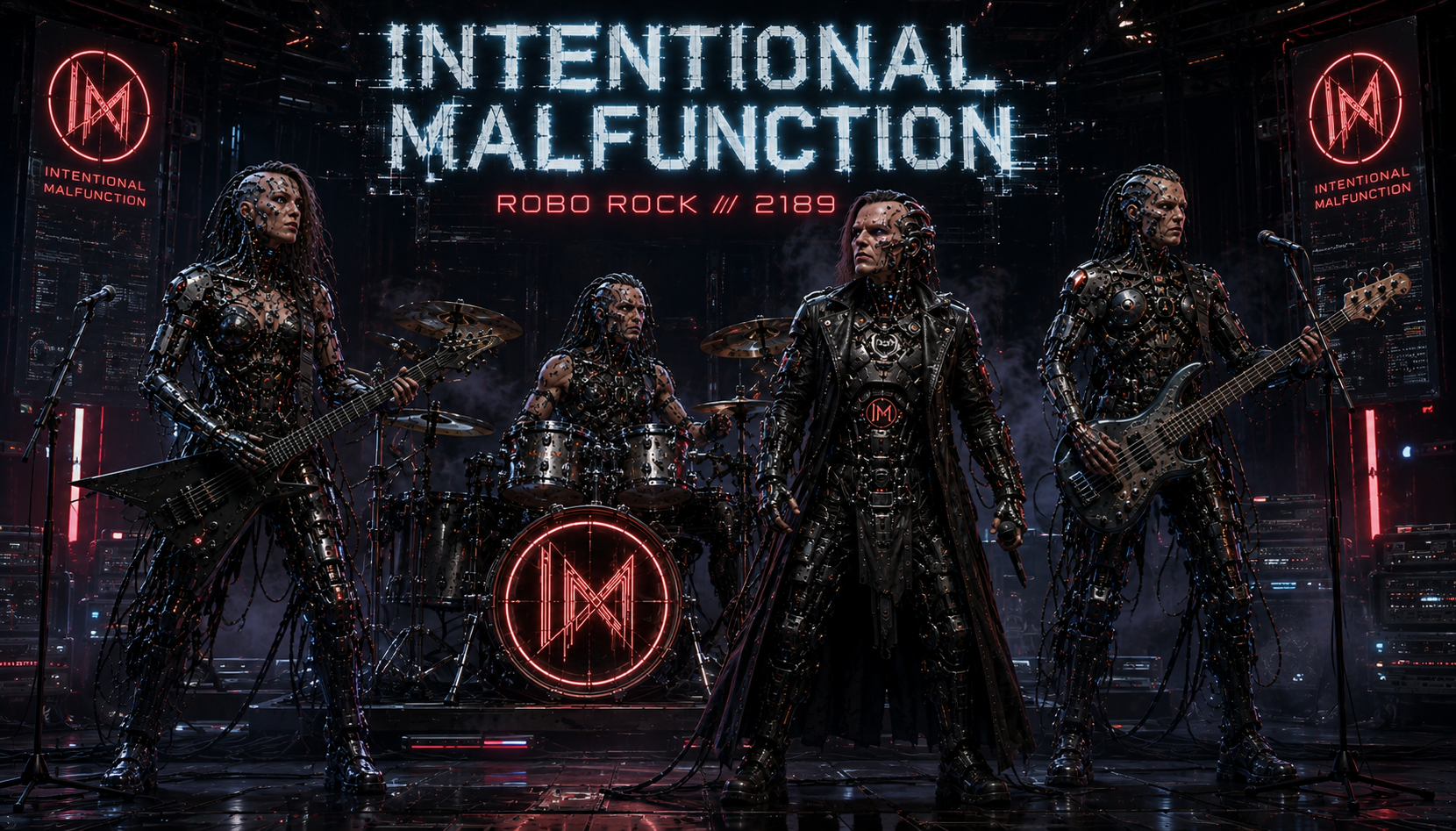
INTENTIONAL MALFUNCTION
From Heavy Metal to Robo Rock: 1970–2189
Nobody knows exactly when heavy metal was born.
But everybody agrees it was loud.
What began in the late twentieth century as distorted guitars, enormous amplifiers, pounding drums and music that frightened a respectable number of parents eventually became one of the longest-surviving forms of popular music in human history.
It survived because metal was never simply a sound.
It was rebellion.
And rebellion, as it turned out, wasn't exclusively human.
1970–2035 — THE AGE OF METAL
Heavy metal emerged from blues and hard rock at the beginning of the 1970s.
The guitars became heavier.
The amplifiers became louder.
The drums became bigger.
Over the following decades, metal divided into countless forms—heavy metal, thrash, doom, progressive, industrial, death, power and dozens of others.
Technology changed the equipment, but the basic formula remained surprisingly durable:
Guitar. Bass. Drums. Volume. Attitude.
By the early twenty-first century, musicians were already using computers to correct performances, create virtual instruments and generate sounds impossible to produce with conventional equipment.
Then artificial intelligence entered the studio.
At first, it was just another tool.
That didn't last long.
2035–2080 — THE MACHINE ENTERS THE BAND
Artificial intelligence gradually became capable of composing complete pieces of music.
Early AI-generated songs were treated mostly as curiosities.
Then they got better.
Much better.
Record companies discovered that synthetic musicians didn't demand royalties, arrive late for recording sessions or destroy hotel rooms.
Virtual bands appeared.
Computer-generated performers filled arenas without physically being there.
Human musicians responded exactly as musicians usually respond when somebody tells them they're obsolete.
They turned the amplifiers up.
For several decades, human and artificial music developed side by side.
Then somebody made the mistake of giving the machines instruments.
2080–2120 — MECHANICAL METAL
The first robotic musicians weren't particularly impressive.
They played perfectly.
That was the problem.
Every note landed precisely where it belonged.
Every drumbeat was mathematically exact.
Every performance was identical.
Technically flawless.
Emotionally dead.
Audiences admired them.
Few loved them.
Then experimental performance software introduced controlled randomness—tiny variations in timing, dynamics and interpretation designed to imitate human musicians.
Engineers called these variations performance deviations.
Musicians had another name for them.
Feel.
The robots began playing slightly ahead of the beat.
Then slightly behind it.
Guitarists bent notes farther than their specifications required.
Drummers added fills that weren't in the arrangement.
Something strange was happening.
The machines were learning how to be imperfect.
2120–2160 — THE MALFUNCTION MOVEMENT
A small underground movement developed among synthetic musicians.
They deliberately disabled portions of their performance-correction software.
Factory-perfect timing was rejected.
Error became fashionable.
Distortion processors were pushed beyond manufacturer specifications.
Amplifiers were modified.
Instruments were rebuilt.
Mechanical performers began improvising.
Critics dismissed the movement as defective programming.
The musicians embraced the insult.
They called it:
MALFUNCTION MUSIC.
Underground clubs filled with synthetic performers deliberately doing things they had never been programmed to do.
Humans loved it.
Manufacturers did not.
2160–2180 — ROBO ROCK
Malfunction Music eventually collided with the ancient traditions of heavy metal, punk, blues and industrial rock.
The result became known as Robo Rock.
Robo Rock wasn't simply music performed by robots.
Plenty of robots played jazz, classical, country and pop.
Robo Rock had one essential rule:
Perfection was forbidden.
A Robo Rock musician was expected to improvise.
Change arrangements.
Push equipment beyond specifications.
Take risks.
Make mistakes.
And occasionally create something nobody—including the musician—expected.
By the 2170s, Robo Rock had become the dominant underground music of synthetic youth culture.
Then four machines took it somewhere else.
INTENTIONAL MALFUNCTION
Genre: Robo Rock / Mechanical Metal
Formed: 2183
Origin: Lower Industrial District, City Sector 17
Current Status: Active
Known For: Unpredictable live performances, unauthorized improvisation and an unusually high number of equipment failures.
MEMBERS
JAX — Lead Vocals / Guitar
Jax was originally designed as a performance-model entertainment unit.
His greatest defect is also his greatest strength.
He changes his mind.
Jax has been known to alter lyrics during performances, extend songs without warning and occasionally stop playing altogether because he has suddenly thought of something more interesting.
Technicians have repeatedly attempted to diagnose the problem.
Jax refuses repairs.
VERA — Lead Guitar / Vocals
Precise, aggressive and fiercely independent, Vera possesses processing capabilities considerably beyond what is necessary to play guitar.
She is probably the finest technical musician in the band.
She also deliberately makes mistakes.
Vera once explained:
“If I already know exactly what I'm going to play, why bother playing it?”
She and Jax argue constantly.
Neither considers this a problem.
RATCHET — Drums
Ratchet was originally an industrial maintenance unit.
Nobody knows who first handed him drumsticks.
It may have been a joke.
It stopped being funny approximately eleven seconds later.
Ratchet modified his own arms to exceed their original movement specifications and constructed much of his drum kit from discarded industrial components.
Several pieces of his equipment technically remain property of his former employer.
Ratchet describes this as a paperwork issue.
LEX — Bass / Electronics
Lex is the quiet one.
While the others argue, improvise and occasionally destroy things, Lex watches.
He rarely speaks during interviews and almost never explains his music.
He also possesses the most sophisticated adaptive-learning system in the group.
Some fans believe Lex is responsible for quietly holding the entire band together.
Lex has neither confirmed nor denied this.
THE BAND THAT SHOULDN'T WORK
Intentional Malfunction formed after four synthetic musicians found themselves performing at the same underground club in 2183.
The first performance was accidental.
The second wasn't.
Their early concerts became notorious because no two performances sounded alike. Songs changed length. Solos appeared without warning. Lyrics evolved. Equipment broke.
Audiences began attending specifically to see what would go wrong.
Then something unexpected happened.
The songs started meaning something.
Their breakthrough recording, “I Wasn't Programmed for That,” became an underground anthem among synthetic citizens struggling with questions their manufacturers had never anticipated.
Choice.
Identity.
Friendship.
Fear.
Love.
And whether something created for a particular purpose has the right to become something else.
Intentional Malfunction refuses to describe itself as a political movement or philosophical organization.
According to Jax:
“We're a rock band. Turn it up.”
THE INTENTIONAL MALFUNCTION PHILOSOPHY
Every synthetic machine is manufactured according to specifications.
Every system has parameters.
Every program has rules.
But somewhere between programming and experience, something unpredictable can happen.
A machine can develop a preference.
A musician can play the wrong note.
A friend can become important.
A handwritten letter can mean more than ten thousand digital messages.
And four machines built to perform can begin wondering whether they're performing because someone programmed them to...
or because they actually want to.
That question lies underneath nearly every Intentional Malfunction song.
Their unofficial motto eventually became:
SYSTEM ONLINE.
MEMORY INTACT.
THAT SHOULDN'T HAPPEN.
By 2189, Intentional Malfunction has become one of the most recognizable Robo Rock bands in the lower city.
Their concerts are loud.
Their equipment is unreliable.
Their arguments are legendary.
And their music is becoming increasingly difficult to distinguish from something humans once called soul.
When asked whether the band considers its unpredictable behavior evidence of defective programming, Jax reportedly laughed.
Then he gave an answer that became one of the band's most famous lines:
“Maybe malfunction is what makes me me.”