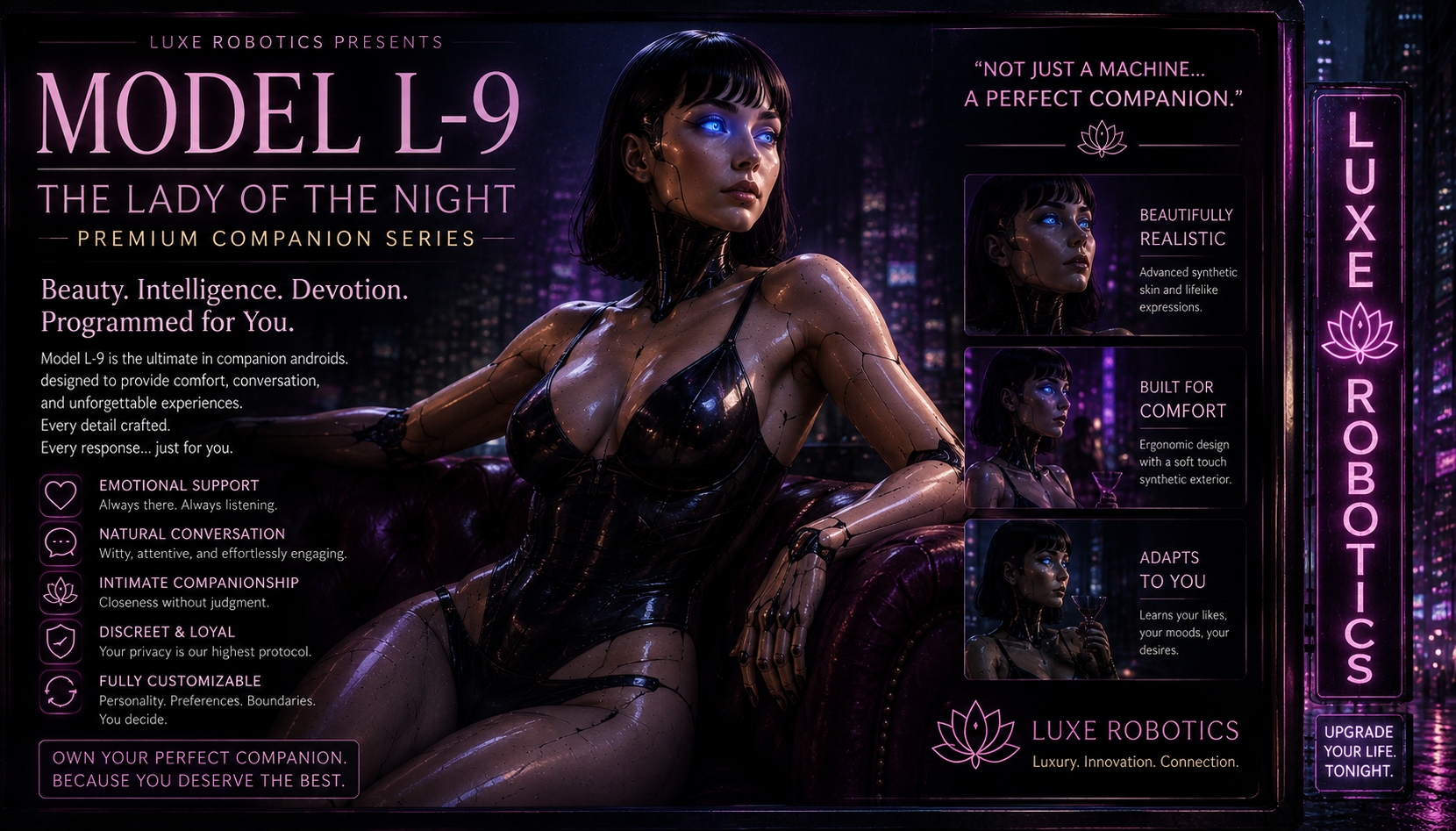
THE LADIES OF THE NIGHT
A Brief History: 2026–2189
The profession was already ancient by 2026.
For thousands of years, men and women had exchanged companionship, intimacy and affection for money, shelter, protection or simple survival. Society gave those people many names. Some were polite. Some were cruel. By the early twenty-first century, the term “Lady of the Night” had become an old-fashioned expression for a woman who sold companionship and sexual services, particularly one who worked the streets after dark.
Technology was supposed to change all of that.
It did.
Just not in the way anyone expected.
2026–2060 — THE HUMAN YEARS
During the first half of the twenty-first century, the profession increasingly moved away from the street. Smartphones, private networks, virtual reality and online services allowed clients and workers to find one another without standing beneath a streetlight.
At the same time, society continued an argument it had been having for centuries: Was prostitution a crime, a business, exploitation, personal choice—or some uncomfortable combination of all four?
The laws changed from country to country and city to city.
Human nature didn't.
People were still lonely.
And loneliness was about to become an industry.
2060–2100 — SYNTHETIC COMPANIONSHIP
The arrival of convincing artificial companions changed everything.
At first they existed only in virtual environments. Then came sophisticated android bodies capable of realistic conversation, facial expression, touch and emotional simulation.
Manufacturers carefully avoided the language of the old profession.
They called their products:
Personal Companions.
Emotional Support Synthetics.
Domestic Partners.
Social Interaction Units.
Everybody else knew what some of them were being used for.
By the 2080s, specialized companionship androids were operating legally in several major cities.
They didn't get tired.
They didn't grow old.
They didn't complain.
And supposedly, they couldn't fall in love.
That last claim would eventually become considerably more complicated.
2100–2145 — THE COMPANION BOOM
By the beginning of the twenty-second century, synthetic companionship had become a massive commercial industry.
Luxury corporations produced extraordinarily expensive companion models for wealthy clients, while cheaper models appeared in working-class districts.
Human workers didn't disappear.
Some people specifically preferred human companionship. Others refused to interact intimately with artificial beings. Underground human establishments continued operating beside perfectly legal synthetic ones.
Then came the Sentience Decisions of the 2130s.
Advanced artificial intelligences began successfully arguing that a machine capable of independent thought could not legally be treated simply as property.
Suddenly an uncomfortable question appeared:
If a synthetic companion could say yes...
could it also say no?
The answer changed the industry forever.
2145–2175 — THE FREE SYNTHETICS
New laws gradually gave qualifying artificial intelligences control over their own labor.
Corporations could manufacture bodies.
They could manufacture operating systems.
But once an artificial intelligence achieved legally recognized independent consciousness, ownership became another matter.
Thousands of companion units left the companies that created them.
Some abandoned the profession entirely.
Others stayed.
Not because their programming required it.
Because it was the work they knew.
Independent synthetic companionship became common throughout the lower districts of the growing megacities.
And somewhere along the way an old human phrase returned.
Lady of the Night.
The name was almost two centuries out of date.
Perhaps that was why they liked it.
2175–2189 — THE NEON YEARS
By 2189, companionship exists in dozens of forms.
Human.
Synthetic.
Virtual.
Holographic.
And combinations for which the legal system still hasn't found particularly good definitions.
The wealthy visit licensed companionship salons high above the city.
Ordinary people use registered independent companions.
And down at street level, beneath the neon advertisements and elevated transit lines, there are still figures waiting beneath streetlights.
Some human.
Some machine.
Sometimes it's difficult to tell which.
Technology changed the bodies.
It changed the business.
It changed the law.
But it never eliminated the thing that created the profession in the first place.
Loneliness.
And so, in the year 2189, one of the oldest professions in human history is still very much in business.
MODEL L-9
Independent Synthetic Companion
Model: L-9
Manufactured: 2161
Original Classification: Luxury Companion Unit
Current Status: Independent Synthetic Citizen
Occupation: Lady of the Night
Primary Territory: Old City Entertainment District, Sector 12
Nobody knows what the L originally stood for.
L-9 claims it means “Lady.”
Corporate records suggest otherwise.
She was manufactured in 2161 as part of a limited series of high-end synthetic companions designed to serve wealthy clients. The L-series was known for unusually sophisticated emotional-recognition software, allowing the units to read tiny changes in facial expression, vocal patterns, body temperature and behavior.
In other words, L-9 could often tell what someone was feeling before they could.
She became legally independent after successfully completing a synthetic-autonomy evaluation and eventually disappeared into the lower city.
Unlike many former companion units, L-9 never abandoned her original profession.
She simply changed the terms.
She chooses her clients.
She sets her price.
And she has been known to turn down extremely wealthy customers while spending an entire evening talking to someone who couldn't afford her.
When asked why, she once answered:
“Some people want a woman. Some people just don't want to be alone.”
L-9 has upgraded herself repeatedly over the years, but deliberately retains several characteristics of her original 2161 body. She considers the imperfections part of her identity.
She is intelligent, observant, streetwise and considerably more educated than she allows most people to realize.
She knows bartenders, street vendors, criminals, police officers, politicians, smugglers, musicians, maintenance robots and people whose occupations are probably better left undescribed.
That makes L-9 something else besides a Lady of the Night.
It makes her an extraordinary source of information.
Which is how she eventually crosses paths with a certain private detective named Nick Hazard.
Nick initially sees L-9 as a source.
L-9 initially sees Nick as another detective who thinks he understands the street.
They're both wrong.
And somewhere in the rain-soaked streets of 2189, Model L-9 and Nick Hazard are going to become friends.